
The Technological Singularity as Story
An interview with singularity philosopher Nikola Danaylov

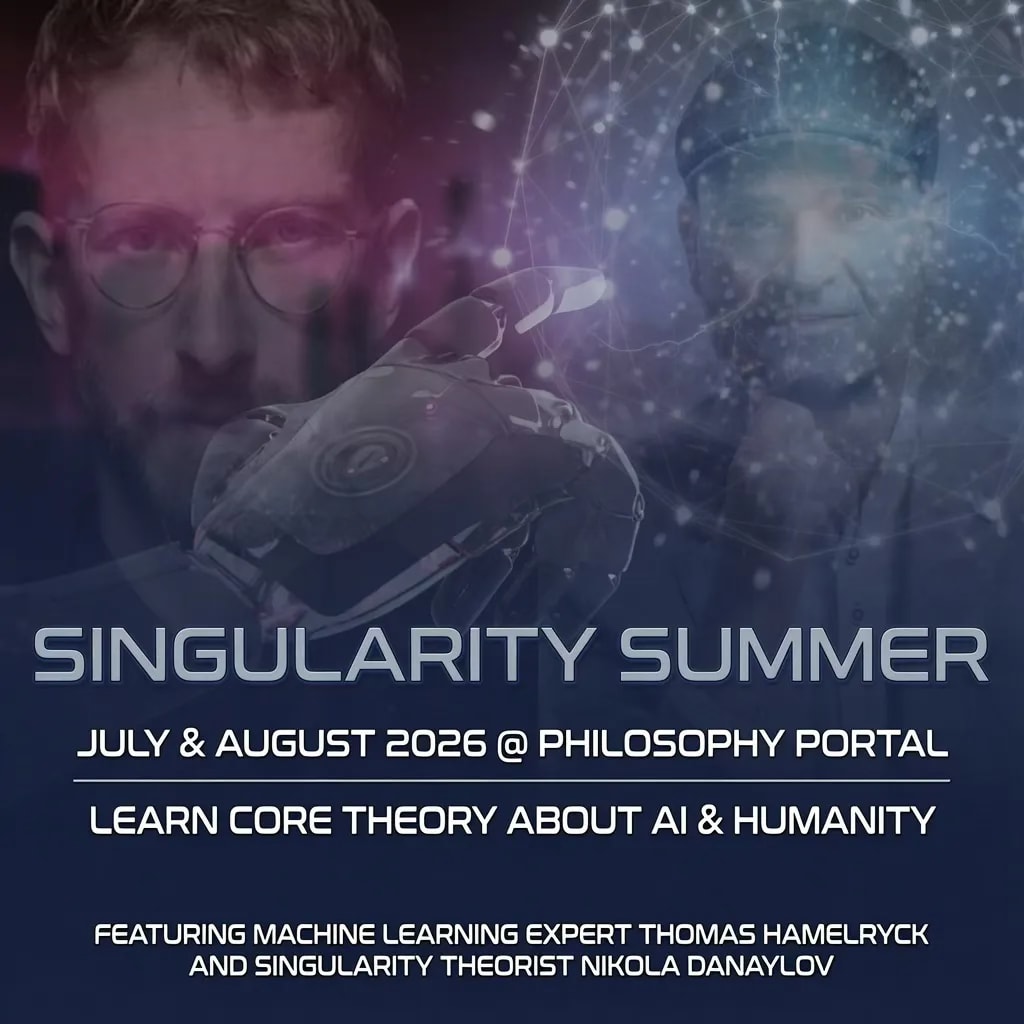
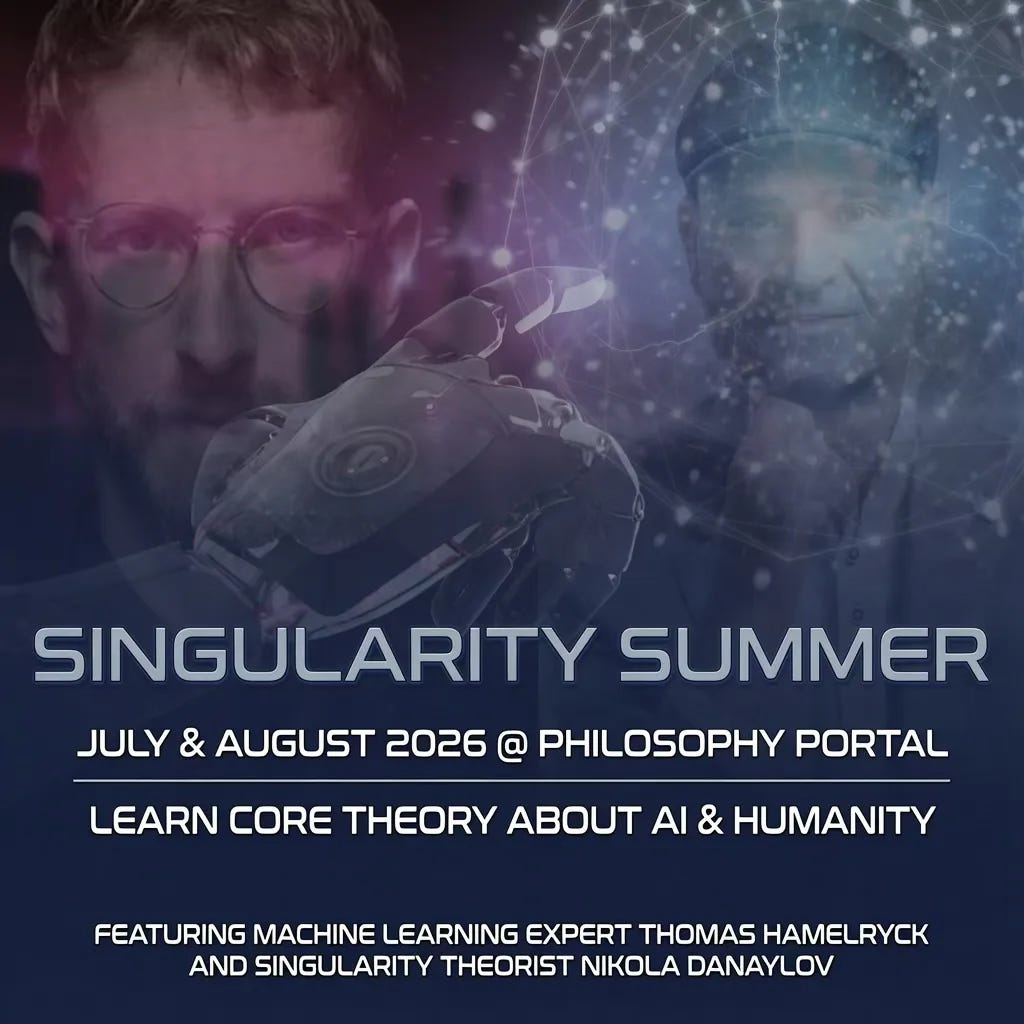
This July and August at Philosophy Portal, we will be hosting machine learning expert Thomas Hamelryck and singularity theorist Nikola Danaylov for a two-month exploration of the notion of technological singularity.
The first half of the course will be focused on the nature of machine learning, its real and its mythology, its limits and its potential, as well as the practical consequences for human relationships and institutional development.
The second half of the course will be focused on the nature of story itself, the human story, the story of capitalism, technology, politics, and the question of whether or not we need to learn how to rewrite the human story in the face of 21st century technological developments.
Both Hamelryck and Danaylov have dedicated their life to these topics. Hamelryck on machine learning and Danaylov on the question of story in the context of singularity.
To join us, check the link in the description for the full course, or consider becoming a member at the portal and get access to all of our live events as well as our entire recorded history.
What you are about to read is an interview with singularity philosopher Nikola Danaylov. This interview functions as pre-course content for Singularity Summer. For the full video, see:
1. Who is Nikola Danaylov and how did you first become interested in the technological singularity?
Well, that’s a deep and ancient question, perhaps. So first part, who am I? If I were to put myself in one or two words in a short sentence, I would say I’m a curious person. I’m a curious person who wants to learn. That’s what I feel like I am, I am a person who has a lot of questions and wants to learn. But curiosity is perhaps my driving impetus, which is an energy, which is why I’m very scattered and not consistent or always coherent and often contradictory.
I contain multitudes.
So in terms of discovering the technological singularity, it all happened in a very fortunate and strange coincidence around 2006. And I can’t remember which book I read first, but it was two books that I happened to read completely randomly side by side or one after another, which was Charles Stross’s Accelerando, and Ray Kurzweil’s The Singularity is Near.
They are basically the same exact book. The only thing is Ray Kurzweil’s book, The Singularity is Near, is nonfiction. And Accelerando is science fiction, but it is 100% about the singularity. Accelerando is based on a short story that Stross published in the late 90s, I think it's called Lobsters, which is kind of super ironic, given that OpenClaw is this huge thing. That’s almost 30 years ago, now it is a reality. Now we have those agentic AIs that are literally lobsters, or many people call them lobsters.
Now how that came to be, how that materialised in our strange universe, is a whole other thing, because many engineers don’t even know about Charlie Stross, and haven’t even read the story, but somehow it ended the same way.
Our universe is mind boggling.
2. Could you give a few examples of how The Singularity Is Near and Accelerando mirror each other or inform each other?
Well, the whole kind of acceleration trend, or what Ray Kurzweil calls “The Law of Accelerating Returns” is captured in a very famous graph. This graph was created by a woman, Kathryn Myronuk. I actually met her at Singularity University.
In any case, her graph for Kurzweil captures Moore’s law before Moor’s law and after Moore’s law, and basically covers almost everything, if you listen to Ray Kurzweil’s claims.
Now, it is hard for people to connect a graph to their lives. The graph is still kind of clinical, very remote. People don’t always get it. But if you take that graph and put it in a story, give it flesh and blood, give it characters that the reader cares about, maybe even loves, or has empathy for, and maybe even associates with and identifies with, then the graph becomes real. Then the graph literally can blow people’s mind, and that’s what happened to me.
So I was intellectually super, super impressed by The Singularity Is Near. The graphs, the examples, focused on hard disk capacities, microprocessors per chip, solar batteries, different technologies from all fields. But yet until you actually put those facts in a story, you can’t really understand, we’re not wired for facts, we’re wired for stories.
Biologically, we are storied animals. We need a story to make sense of the facts. In fact, facts are useless until you wrap them up, or put them within a story, because the story tells you what’s important and what isn’t.
What’s the treasure and what’s the garbage?
What’s the goal and what’s the side effect?
What’s the good and what’s the bad?
Everything that matters, in our life, in our civilization, everything that matters is framed in a story. And that’s how I was kind of lucky enough to really read The Singularity Is Near and Accelerando one after another. My mind was blown out afterwards, and I felt like I cannot do anything else. I had to do something with the singularity, with artificial intelligence. And I have to basically dedicate my life to it.
That’s how I became what people eventually started calling a “futurist”, which is a word I don’t like at all, because I still think that, at the bottom of it, I’m just a curious person.
By the way, I never tried to predict the future. I am more about trying to inspire people to create the best possible future.
3. Kurzweil’s The Singularity Is Near works based on cosmic evolution as a story. How do you understand the function of cosmic evolution as a story?
I think what you’re pushing me towards here, perhaps, or that’s how I perceive it anyway, is the teleology of Kurzweil’s inherent argument. I have substantial issues with Kurzweil’s teleology.
I think Kurzweil is a brilliant man. I’ve met him personally, and did a wonderful interview, and spent a number of hours in his office. He is super humble. He is brilliant. He is a genius. And I love his work, and his work has impacted me and many other millions of people around the world.
Moreover, I think he is a wonderful inventor and a wonderful human being, which is a rare coincidence of personality and skill and character. So I’m a big fan of his.
However, it doesn’t mean that I agree with everything that he talks about. And it doesn’t mean that there are no sort of blind spots in his claims. And biggest of all, in my opinion, is his inherent teleology. And by that, I mean that, ultimately, Ray Kurzweil’s ideas converge to a single linear, if you will, storyline. That is what he calls the “Six Epochs” of the singularity.
The problem with those epochs is that they are basically creationist in character. People will be shocked by that claim. To me, the creationist idea is about this kind of special unique place that Homo sapiens or humanity takes in the universe. We are framed as God’s chosen children, and our planet is a garden made for us, made for the taking, to make our lives better, to serve us better. And it is on a planet in the center of the universe, and everything else gravitates around us.
So the creationist thinking is, okay, we are the most important species of them all. All other species are subservient to us, our world is the center of the universe. But now, historically, science has gone on to discredit all of those claims. We know that our planet is an insignificant planet in the backyard of our Milky Way, gravitating around an insignificant little star that nobody cares about. So we are really in this corner of the galaxy, probably the back end of the universe.
In that sense, the kind of special place that we have, from a religious point of view, has been proven over and over again, that it is not the case.
Now, Ray Kurzweil is a great scientist, but here’s where his science becomes religious. First, the way they function, they use the same kind of story and promise the same outcome, which is to say immortality and abundance, just like religion. In other words, they promise heaven. Secondly, it treats humanity as this very species species, one of a kind. And you know, from my point of view, if you look at evolution, evolution doesn’t have a linear culmination point in development, no matter how much we would like to be that special. Evolution is rather a branching tree with endless kinds of experiments running, and many of them dying out as we speak, and many others branching off and continuing.
So for Kurzweil, ultimately, the final several epochs of the cosmos, would be something like we have these giant computroniums surrounding stars, absorbing all the energies, and basically powering up the required intelligence. And then the final outcome is that there is no more dumb matter in the universe, but we have smart matter, the universe wakes up, as Kurzweil says it.
Now, it doesn’t get more religious than that in my books, the universe literally wakes up. That’s like God himself, in the Second Coming of Christ Himself, right? We all wake up to the reality of Christ, or pick your God, you know.
And so, that to me is this kind of teleological single point of view, a story which impoverishes the possibilities of many different stories, many different futures that evolution creates by the fact that it is a branching kind of phenomenon. Evolution does not converge to any kind of predetermined end. Teleology is all about everything converging to a single point.
Teleology is a word that was invented by Aristotle, it means purpose in Greek. So the telos of a knife is to cut. If you have a sharp knife, and it cuts, it’s fulfilling its telos. It’s a good knife. But if the knife is dull and it cannot cut, it’s failing to fulfill its telos, its original purpose, and therefore its not a good knife.
Now that may be a good thing to say for knives, but for human beings, or for intelligences like us, that boxes us in a frame that creates only unidirection. It does not allow for any other possibilities for the flourishing of our intelligence, it only predetermines a single direction. Therefore, anything else that deviates from that predetermined direction is a deviation or aberration, and should not be allowed or incentivised in any way.
That to me is the impoverishment of that teleological conception, which is highly religious, and it replaces the religious heaven with a scientific or transhumanisitc heaven. It functions in the same way in the human brain, using the same neural structures, that any powerful religious story does. It promises the same outcomes, and therefore impoverishes all other future possibilities in front of us.
4. Why did you originally chose to blog under the name of Socrates?
I should answer the question of how, which is usually always a secondary question in my book. Because originally it was the how and then I came up with the why, one of the few exceptions in my life.
So I graduated with a Masters’s degree in International Relations, with a focus on artificial intelligence in times of war. I wrote a thesis around 2007 or so about the drone warfare which was just budding at the time, originally in places like Iraq and Afghanistan. At the time, there was just half a dozen predator drones that the CIA had hacked with a couple of hellfire missiles, and they were taking out what they would call a target of opportunity.
My thesis was arguing that we did not witness what was the most common and popular thesis in the Department of Political Science and International Relations at that time, which was Samuel Huntington’s thesis, the clash of civilization. My claim was that we’re not witnessing a “clash of civilisations”, but, the first time in history when increasingly automated machines are taking increasingly automated decisions, as per whether a human being would live or die.
To me, that was a radically new phenomenon that was going to transform both the face of warfare as we know it, but potentially our entire civilisation.
And so anyway, I graduated in 2008 with a Master’s degree. I graduated during the Great Recession of 2008, the global financial crisis hit. In applying for work, I stopped counting after 300 resumes. I had only one interview. And I was on the Dean’s list with a Master’s degree from one of the great universities in Canada, and all kinds of academic awards and this and that. I got one interview, which by the way, apparently didn’t go that well because nobody called me afterwards.
And then I thought, well, what can I do with my life?
In the meantime, I was reading the first blog on artificial intelligence with technological singularity and transhumanist themes, at the time it was called “Singularity Hub”. And they released a call for public writers, they were hiring staff writers. I thought, I’ll be perfect for these people, I just basically wrote my Master’s degree thesis on this, and people say I am a decent writer.
So I sent an application. And it took a couple of weeks before I realised that they’re not calling me back either, and so it was basically one failure after another.
A couple of weeks after I realised they’re not calling me either, I had this crazy, crazy thought. I don’t even know how it popped into my head, but it was something like, well, maybe I don’t need them. Maybe, just maybe, I can start blogging on my own. How hard could it be?
Now mind you, I was a philosophy undergrad and an International Relations and political science graduate student. So I had no idea about HTML, programming, design, anything like that.
I had taken one elective computer science class because that was my science requirement, and that was it. So I had to start from the beginning, from ground zero, with HTML coding and stuff like that, very slowly. It took like like six months to put up 20 or 30 web pages. And when I was doing this, I was wondering: “what happens if I fail? What happens if I succeed? How do I do it?”
And you know, there was this cartoon at the time on the internet, that nobody knows that you’re a dog. I was like, well, why don’t I call myself Socrates, right? Because who knows how this thing is going to turn out anyway? Maybe it will be a total embarrassment, and I don’t want to put my name behind it. Plus, I’m just kind of experimenting and testing the water, and who knows, I’m not a technical guy.
So why don’t I adopt the name Socrates?
I didn’t come up with the name Socrates myself, because you would say, well, that’s kind of very presumptuous, you know. If you embrace your own moniker, Socrates, wouldn’t that be something? But I was already called Socrates when I was in the army. In Bulgaria, if you were 18 in the mid-1990s, there was compulsory military service, which is to say all men over 18 years old must serve in the arm, whether before university or after. Generally, if you were not accepted to university right out of high school, you go straight into the army, and I did go and serve in the army.
In the army, asking questions, being a curious person, is not a very good strategy for survival, you know; especially when it comes to senior military officers, a lot of egos, loaded weapons and extreme cases of stress, pressure, and armed weapons. In that kind of environment, when people started calling me Socrates, that was not a compliment. That was an insult.
But eventually, I got to embrace it because I was like, “well, it is what it is. Maybe it’s accurate, why fight it if that’s what people think?” I can’t choose anyway the alias that people are giving me.
When you’re in the army, everyone has a nickname. And it’s not the person who picks the nickname, it’s the other soldiers who pick it for them. So that was my name, Socrates. And so when I started blogging, that was naturally the first thing that came to my mind. I’m just going to use Socrates. Plus, I’m the man with the questions, that’s what they told me, that’s who they told me I was in the army. I was asking way too many questions for my own good, or the good of anyone else around me.
And so, that’s a long story, but that’s how I ended up with the moniker Socrates.
5. How did what you’re doing eventually become the Singularity Weblog project?
Right, so originally I started with the website called “Singularity Symposium”, which, by the way, someone appropriated now. What happened was, I started with an HTML self-hosted website called singularitysymposium.com. And it took me a year and a half, a year at least to have like 60 or 70 web pages, and they were all hand-written and hand-coded HTML, everything from beginning to end.
And then one day I discovered WordPress. I was like, “oh my God, this is like a word processor.” If you could actually type in a Microsoft Word document, you don’t need to do any HTML. You can actually blog and it’s all there and you don’t have to ever see the code. This is just pure genius, right?
I started listening to these things called podcasts around 2009, and I thought, “well, I should start interviewing some of those cool people and see what I can learn directly from the source.” Because one thing you learn in school, and even in the army, is that the closer you get to a source of information, the more undiluted and pristine and pure and correct that information is. It’s kind of like a broken telephone, right? The further away you get, the more distorted the message becomes. And so the mission is to get straight to the source or as close to it as possible. Interviewing people seemed to me the most logical way to accomplish that.
I thought, “okay, I’m going to start recording people with the podcast, but I don’t know anything about audio engineering.” I’m not an audio engineer. I don’t know the first thing about microphones. I don’t know the first thing about editing. I don’t know anything about anything. How the hell would I do that?
I also have a pretty strong Bulgarian accent, people would listen to me and they’ll be like, “oh, this guy can’t even speak proper English. Why the hell would we listen to him about anything ever?”
So I had lack of knowledge, complete ignorance and personal insecurities, all combined in it. But then I was like, “what do I have to lose? Let’s just do it, give it my best shot,” you know. And then I started doing these interviews.
Once I did the first one or two, I discovered that it’s much easier to do an interview if you have a webcam running, because we are very visual body language creatures. We watch the effect of what we say or we communicate in the body language of our interlocutor. And so it’s very helpful if you can actually see the person rather than if you don’t see them at all. Once I started looking at my guests through a welcome, I was like, “well, we have the webcam, why don’t we just record the video too?” So then I had to start editing video too.
One step after another, I started with an HTML website, moved to a WordPress blog, which became singularityweblog.com, or for brevity, you can get there by singularity.info. And my podcast was called “Singularity 1-on-1” for the first number of years. Eventually, I rebranded it to “SingularityFM”. And the original website, I shut it down a few years back, but some scammer apparently noticed that my original singularitysymposium.com website was ranked really well in Google, and they rebooted it from the Internet Archive with a number of gambling and casino links at the bottom of the page or something like that, basically link farming.
And that annoys the heck out of me, but I don’t have any control over that website anymore. So that’s what happened. It’s one of those good lessons that tells me I should have held onto it and just shut it down because now I’ve lost control over that.
But it is what it is, it’s a lesson that you have to learn just like I did, the hard way.
6. What message are you trying to send to the singularity community with the slogans “technology meets philosophy” and “exponential change meets human values”? How has this message been received?
Right, that’s the crux of the matter. Let me backtrack a little bit, just to make it more clear. For the first number of years of my podcast, people had the wrong impression that it’s about technology. It’s never been about technology. Technology has been the content.
But the context is always more important than the content because the context determines what content is good, what content is bad, what is valuable and what is not, what’s a treasure and what’s garbage, what’s ultimately the purpose and what is not, what’s useless.
So my content of technology was always in the context of philosophy, which is to say, How does technology serve the purposes of greater humanity? Is it a good thing? Is it a bad thing? Is it something that pushes us forward or backward? Is it making us better or worse? Is it making us stronger or weaker?
Overall, what’s the best attitude that a rational species, hopefully, or a rational individual can adopt towards technology. Ultimately, that kind of culminated in a motto that I have at the bottom of my website at the footer, which says that technology is always the how, but if you don’t have the proper why, you can use the best how in the world, but you would end up doing more damage than good. That’s usually because the why should be the driving motivator, or frame maker, or context creator, and the how should be the follower.
In other words, technology should be the slave, and we should be the master of it, not the other way around. Not like in the many cases that technology has become today: technology is not the end, it’s the means, and we shouldn’t forget that.
So my impetus from the beginning was to push forward that line about the difference between means and ends, the why is the ends, the technology is the how, which is the means. And about the fact that all the most important choices or implications of technology are ultimately ethical ones, which is to say political, and that’s inescapable and unavoidable.
The more powerful a technology is, the greater the ethical implications it will have, and therefore the more political it will become. That’s why it’s been now maybe 10 years or so since the first time I think Donald Trump got elected around 2016. I wrote an article called “Technology is the Future of Politics and Politics is the Future of Technology”. They’re inseparable.
And so originally I would go to all these technical conferences in the 2010s, like 2012, 2011, 2012, with all these nerdy geeky engineers or computer scientists. And I’d go up in their face and say something like, “you know guys, nobody really cares about the details other than you, nobody really cares about how we do things, no matter how much you love it, no matter how much you geek over it, but what people care is about is the so what?”
Is it a good thing? Is it a bad thing? Why should we or why shouldn’t we do that? And the whole field of ethics is about having the power to do something, but making the choice not to do despite the fact that you have the power.
So I would be in these conferences trying to push that line, and it made me very quickly, very unpopular, let me tell you.
At the time, nobody wanted to hear anything about ethics or philosophy in general. Everyone was consumed by the how, everyone was geeking over the most minute technical details. And I’ve always pushed that those are ultimately not important.
Now, I have to say I’m very happy to observe that people everywhere have woken up to the fact that technology is ultimately a political phenomenon, because it has ethical dimensions or implications, and they’re inseparable. And so instead of thinking retroactively, after the technology is a fact about those ethical and political implications. We should think proactively so that we don’t consider them as a band-aid solution, but we should consider them by design at the outset. And that way, while there is no guarantee we would avoid any negative externalities or risks, at least we would minimize them much more than ever before.
That has been a big shift in the last 10 years that I’m very, very happy to observe. Now the entire world, I believe, has woken up to the fact that AI is here. And that the big choices that AI in particular, but also all super advanced technological progress, whether in genetics, robotics, AI, whatever it may be, ultimately comes down to our ethical choices. And those choices will determine whether we would destroy ourselves, or whether we would survive and thrive and maybe even spread throughout the cosmos. Not the technology that we have, but how we choose to embrace it.
I grew up in the Eastern Block, behind the Iron Curtain in Bulgaria. And I was 13, 14 years old when the iron curtain collapsed. I can tell you, roughly, we had more or less the same technology in the East and the West. You know, the industrial revolution, trains, cars, spaceships. In the Eastern Bloc, we were very strong on things like mathematics and the sciences, for example, very strong.
But some people built socialism, or attempted to build socialism with it. Other people built democracies or social democracies. Other people try to build fascism.
So you see, the same technology was employed in what I would consider radically different ways with respect to our ethics, and that in terms has implications on our freedom, both individually, and as societies, and ultimately that’s all what politics is about. The choices that we make, the big choices are not the technological ones, they’re the ethical ones, and they change the nature of the impact of that technology.
7. Why should people get involved in the deeper why and so what of exponential technologies and the singularity? Can you expand on your own perspective on ethics and politics, perhaps in contrast to what people in the technical fields have thought about ethics and politics?
Yeah, so the other big gripe that I have with Silicon Valley is similar to the gripe I have with Ray Kurzweil, and his sort of indisturbable teleology; in Silicon Valley, they have their deterministic law of the universe equaling the claim that the march of technology is unstoppable, and we might as well just get along with it.
I have problems with that just as much as I have problems with Ray Kurzweil or teleology, because neither the speed, but especially not the direction the technology goes, is natural or inevitable, or follows some kind of law.
We had the same technology in the 1930s and 40s Europe, and again in the 20th century, that same technology produced fascism, socialism/communism, and capitalist democracies. So the difference wasn’t the technology, the technology is not necessarily deterministic, is what I’m trying to break the presumption of here. It is not a single path, it is just like evolution, that’s why I hate teleology, because it comes up to a single conclusion and everything else is wrong. Just like in religion, God said it, or it is in the Holy Book, and everything that deviates from that is wrong, and shouldn’t be, and it’s like to be condemned, and burned at the stake even.
Whereas ultimately technology should allow for a greater and greater freedom. That’s my ethical stance with respect to technology. Is it producing greater freedom or lesser freedom? That’s one of the many different kind of ways of measurement. And single paths not only never produce more freedom, but are evolutionarily super dangerous. I mean, look at evolution. Evolution throws everything at the wall in every single direction. It’s like a sphere of expansion of possibilities, that’s why we have millions upon millions of species.
If you have a single species, no matter how well adapted it is to a specific environment, you’re putting all your eggs in one basket. And what that means is that if something goes wrong, poof, you have extinction. If you have diversity, even if a number of those species go extinct, life continues, evolution continues. There is a myriad of branching possibilities that are ever growing.
That’s what evolution is all about. There is no convergence. It is divergence of freedom and possibilities. And so if we, to answer your question and connect it to what I just said, if we embrace the claim that Silicon Valley pushes forward under the idea that technology’s march is inevitable and unstoppable, and if you listen to them, in a very specific single direction, then we might as well watch Netflix, drink beer, and eat pizza, because we’re all just spectators, right?
I mean, there’s nothing we can do. It’s inevitable, it’s unstoppable, and it is going the way it’s going. Who the hell are we to do anything?
But that’s why I have problems with people who make those kinds of claims, because that’s not a prediction, that’s a prison. And my claim is exactly the opposite. My claim is the future is not a prediction, which says that it’s inevitable, to paraphrase Cory Doctorow, but the future is a story which tells you that it’s up for grabs.
And it tells you that you can be a spectator of that story, or you can get your hands dirty and you can try to be the author of your own story, the author of your own story as an individual. So you do have agency at the individual level, but you also have agency at the collective level. We can together become the authors of our own story as a species. And we can create a myriad other possibilities which any narrow-minded teleology would not allow space for.
In other words, it creates a clearing that we can populate with an expanding sphere of evolutionary possibilities rather than having a single track that serves the Silicon Valley big tech elites and their profit margins. And anything that deviates from those is to be exterminated or condemned and is reprehensible.
So it’s all about the agency that we all have, and we must reclaim, and the fact that we can be, and we must become, the authors of our own story, both individually and collectively.
8. You’ve been interviewing experts for your podcast for 15 years now. What are the most memorable interviews that you’ve conducted? What are the interviews that have taught you the most about the relationship between technology and philosophy specifically?
Wow, that’s a really tough question. That’s like, I know you have only one child, but that’s like asking a parent who has a number of children, who is your favourite child. And you know, even if parents do have favourites, it’s not a very wise thing to say publicly, who is your favourite child, for a number of reasons.
Now, I’ve done over 300 interviews and I’ve learned a lot. And, you know, having a conversation, asking good questions is a skill. It is a skill that takes a lifetime pursuit to learn. I am at the beginning of that journey. I suck a lot less than before.
I mean, when I watch my original interviews 10, 15 years ago, I often cringe. If back in the day I would screw up two or three hundred things per interview, you know, just on the actual part of interviewing or conversing with people, not to mention another two or three hundred things on the technical side of things. Nowadays, maybe, hopefully, I am down to maybe 50 or 60 on each of those sides, that I could have and should have done better.
And I should know by now to not do, but I still do. So no interview is perfect. Some are better than others, for a number of reasons. Sometimes it’s just chemistry, sometimes it’s just mood. Sometimes it could really not work out for a variety of reasons. Like I had Lawrence Krauss on my podcast, and it was just one of those days, where he had a dental operation right before the interview. And I had a killer headache. And it was just like one of those interviews that we both really struggled to do. Now I still learned a lot, I still read his book in full, as part of my prep for the interview before that.
Also, out of the 300 and some interviews, I probably have had five or six that I never published, each for a different reason. So maybe you could call it a 2% failure rate in the sense that I recorded an interview and then for a variety of reasons, after the fact, I decided not to publish it. So those were a complete disaster.
The interviews that really stand out in my mind are the interviews that break the mold that I am within, the interviews that literally blow my mind and take me to another level that I previously considered not possible.
I’ll give you a couple of examples.
The first such example that comes to my mind is my interview with Karl Schroeder. Schroeder is a science fiction writer from Toronto, Canada. He’s kind of like the hidden gem of the science fiction world, and he’s also a fantastic futurist. He has at least 10 books, I think, all of them fantastic. I’ve read four or five of them.
When I interviewed him the first time it was probably 10 or 12 years ago, maybe 13 or 14 years ago, actually. He told me this, the singularity is a good model, it’s an interesting model, it’s an interesting concept, but consider it as a lens through which you see the world.
So when you’re a photographer, you know, you have a lens. Let’s say the standard lenses are either a 35 millimeter lens, or a 50 millimeter lens, usually. And then you have wider lenses. Anything wider than 35 millimeter, like a 24 or an 18 or a 16 millimeter is a wider lens, a wide angle point of view. Then you have telephoto, anything over 50 millimeter is considered telephoto. And he said it is good to have a standard lens, and to look at the world through that lens, but it’s also very useful to take off your lens and put another lens, and look at the world with a different lens, because that different lens creates completely different point of view. And it distorts the world in a different way which stresses certain elements, let’s say the foreground, and reframes the background further if you have a wide angle lens. If you have a telephoto lens, it brings the background forward.
So there is a benefit to changing the lens on your camera because you’re capturing a more full spectrum of the possible perspectives by doing that, and so he told me it is good to have the singularity point of view, but it’s good to take it down and put other points of view, and look at the universe as having many more possibilities than that single point of view called the singularity.
And at the time when Karl told me that, that literally blew my mind because for four or five years before that, I was a total singularity fan and I was a one point of view, one model kind of person. I couldn’t see the world in anything else other than that specific paradigm, especially since at the time I wasn’t even aware of the limitations of Ray Kurzweil’s teleology, and about the fact that it’s creationist in its nature, because just like creationists think we’re special, that kind of scientific technology presumes that we are special, that our intelligence is going to give birth to the cosmic intelligence until the ultimate point where the universe finally wakes up. So you see we’re so special like that, and that’s very creationist.
I’m more of the Douglas Adams kind of point of view: we’re just like some ridiculous, bipedal, ape-descending species on some backyard, god-forsaken, tiny little planet, that nobody cares about, just trying to figure out life, the universe and everything. And the best we’ve got so far is like some ridiculous claim that it’s 42.
So, to me, Silicon Valley saying technology is unstoppable and, you know, unsteerable almost, and it’s all ending up to this massive cosmic teleology is like telling us the answer of the universe is 42. 42 is the answer of everything.
I’m saying, yes, I believed that, unfortunately, for a period of time. And then people like Karl Schroeder came and showed me how short-sighted and narrow-minded that point of view is, because 42 is brilliant, it’s funny, it’s great, but it’s only one of endless possibilities. I’m now all about, let’s look at all the possibilities, and different people are going to like different things in the cosmic possibilities.
By the way, as I said before, that’s a lot less risky too, because we have a lot more possibilities for growth, both intellectually and otherwise. So Schroeder was the first one that kind of blew my mind in that way.
Then another interview that I’ve remembered is Ada Palmer’s most recent interview. I’ve interviewed Ada Palmer three times. She is this historian from the University of Chicago who specializes in the Renaissance. And she writes these massive, massive science fiction novels. She has written a series of four books and the latest book is, I don’t know, 1,000 or 1,200 pages, and all of them add up to 4,000 or 5,000 pages. And I’ve gone through them all, by the way.
But she wrote her latest book is called Inventing the Renaissance: Myths of a Golden Age. And basically it is the idea that we can’t name the Renaissance, and we can’t date it even, and we can’t even say what it means, because every different university department calls the Renaissance something different.
So if you’re in the Department of Political Science, you would claim that the Renaissance is the birth of Republicanism and the first Republics against absolute monarchies. If you are in the Department of Economics, you would say that the Renaissance is the birth of banking and the first capitalist sort of monetary global system. If you are in the arts end of things, then you would say that the Renaissance is the birth of art as separate from religious art, or art that’s in the name of God, but as its own thing. If you are in the Department of the Sciences, for example, you would say that the Renaissance is the birth of science and the first time scientific disciplines taking off away from the religious theology and dogma.
Therefore, each of those departments would give them different dates, even different centuries, different major people, different major pivotal moments, because each one of them looks at the Renaissance as a completely different story. And that story tells them what is the most important, whether it’s banking, whether it’s the fact that you have republican political ideals, whether you have new art, whether you have new science, what have you. Everyone tells a different story.
Most importantly, there are those myths of a Golden Age. To have a Golden Age, you cannot have a Golden Age on its own. You have to have a Golden Age only if there is a Dark Age. So before you invent the Renaissance, you have to invent the Dark Age.
Petrarch, or I think his name originally was Francesco Petrarca, who originally in I think the 1200s, was kind of one of the proto-fathers of the Renaissance, was the guy who first coined the term the Dark Ages. And he gave that name to everything preceding that moment. You see, that’s a political act. That’s politics right there, because it tells you that something is bad, and now we have the opportunity to create something good. And from then on, you’re not just telling a story, you’re telling a political story which has power implications. And from then on, you can divide people into groups of those who are in support, or those who are against.
But again, everyone would have a different concept and idea about what a Golden Age is when it began and so on. So nowadays when a new politicians comes and says, “okay, I’m going to create a new Renaissance,” or “I’m going to create a new Golden Age,” you have to understand at the same time he’s also saying that before me, or the immediate present, the immediate past is a Dark Age, and I’m going to change that. And there is a political purpose in reasoning and machinery working behind those claims.
So Ada Palmer was the first historian who didn’t take a single point of view to say, “okay, no, this is the Renaissance and everything else is false.” She actually went through the entire catalog of all these people going through all these different concepts and ideas and dates and timelines of the Renaissance as a different story. And she said they’re all different stories, and she said you can choose which story you want to embrace, but beware that every story that you choose comes with its upsides and its downsides, with costs and benefits.
So yes you can still make a choice but be aware that it has to be a deliberate choice and you have to be conscious and cognizant of the price you’re going to pay for each of those choices, and nothing is inevitable most of all. There is no such thing as an inevitable progress or direction of history, which is what teleology is all about. Instead, we have history unfolding, and then people retrospectively go and start naming certain events as Golden Age or Dark Age.
But in the Dark Ages, there were many Golden Age things that happened, that were amazing. And in the Golden Age, there were absolutely many horrendously terrible things that happened, but we still call it the Golden Age because we downplay those terrible things.
For example, in the Renaissance in Italy, life expectancy dropped to 18 years of age. So think about it this way, in 1400s Europe, life expectancy was around 38, 39. In the 1600s of Florence, which was one of the richest places in Europe, one of the technologically most advanced places in the world, culturally, economically with banking system, etc., life expectancy dropped to 18. It was so horrible, that one of Machiavelli’s friends asked him to write a history of Italy, or Florence at least, in his case, because the future generations would not believe how terrible the situation was, according to his friends.
That’s why, by the way, we have The Prince, which is written in a dog-eat-dog kind of world. And that happens during that alleged Golden Age, right? The Renaissance, where people couldn’t go on the road without being murdered by bandits, and males didn’t last more than 18 years of age, and there were constant wars and plunders and cities being sucked by this person or that person or that king and the other king. There were religious intolerances, sexual intolerances.
Oh, and by the way, the plague would come along or hang around in the back rooms and the backyards almost constantly and would wipe out, you know, every 50 years or so, would wipe out like a third of the population. So it was horrendous in so many ways, and yet amazing in all the other ways that we know of.
9. Can you tell us about your idea of “context effect”? Where did you first start developing this idea, and what have you learned in acting it out?
The “context effect” came to me as an idea when I was listening to a podcast episode by a person that I love and respect very much. And he was doing an interview and someone finished the interview by saying the classic cliche that “content is king”. The bugged me so badly that I had to react and do a whole presentation against it.
I was like, “no, content is not king, context is king,” because content is just the how or the what, but it’s the why that sets the meaning and the purpose of everything.
By the way, context is the overarching framework, whether it’s religious, whether it’s ethical, whether it’s legal, whether it’s economical, which tells us what’s good or what’s bad, what’s right or what’s wrong, who should marry whom, what to eat, what to believe, what happens when we’re born, what’s the purpose of life, and what happens when we die. That all comes from the context, that all comes from the story.
The content is just data. That’s, by the way, one of the major differences, at least so far, between humans and AI.
So think about it this way: AIs can process gargantuan, almost unlimited amounts of data. But they have no idea what data means. Unless and until they borrow from us. That’s called reinforced learning. That’s called prompt engineering. And what does that do? That basically gives them context. And the context that they get, they borrow from us, it tells them “this is garbage” and “this is good”, “do more of this” and “don’t do any of that”, “we want this” and “we don’t want that”. Good or bad.
We have come up to that context framework through evolution and through millennia, millions of years even of evolution and evolving and living, and then existing as a Homo sapiens for, you know, at least, let’s say 70 or 100,000 years. AIs don’t have that context. So their ability to process data is useless unless and until they get the framework that tells them how to process the data, because you can’t separate the signal from the noise unless and until you have a definition of what is signal, and what is noise. That comes first, in philosophy, there is this discussion or debate about whether you can derive an ought from an is. And the question is, can we even do that? And if you believe that we can’t, that machines don’t need the context, because they can deal with the is, they can deal with the facts. But whether the facts are good or bad, useful or not useful, dangerous or helpful, all that depends on the ought to.
The ought to comes from our evolutionary baggage, from the things that help us survive, from the things that help us thrive, from the things that give us more freedom and put us in less danger. That’s part of our evolutionary baggage, and so that’s why the context is absolutely crucial. That’s why, by the way, you can have people on the left and on the right, looking at the same exact facts, even agreeing on the facts, and vehemently disagreeing on what they mean. The reason is that the same two people look at the same facts with a completely different framework, and that is their context, that is their story. And different stories can take the same exact facts and make them diametrically opposite in terms of their meaning, in terms of whether they’re good or bad, whether they should be incentivized or disincentivized. So that’s why for me, the crucial point that I’ve been working on for the last few years is storytelling, because that’s how we get our context. We get our context by embracing a story.
That story, in many cases, has been, historically speaking, religious. But it can be also political in terms of communism or socialism. Those are also stories. Fascism is story. Nationalism is a story. So one way or another, we need a context that helps us make sense of the world, that gives us direction, that tells us who we are, that tells us where we’re coming from, and that tells us where we’re going.
At least so far, machines are unable to supply that. What they’re able to do is imperfectly borrow from us. And as long as we are in control of that context, we would be the smarter species, I believe. The moment we lose control over the context, we are in trouble.
That’s why all my work has been about trying to rewrite that context, that overarching story. Because to paraphrase Antonio Gramsci, we are living in a situation where the old world is dying, and we can all see that, but the new world is struggling to be born. And that is the time of monsters. Those monsters come at very high price, individually and also collectively.
My work is determined at two levels: one, how can we minimize the reign of monsters as little as possible, both in terms of duration, but also in terms of reach and capacity, hopefully. Two is, what would be the overarching context or story that can create the framework for the birth of the new world in such a way that it would maximize freedom and minimize danger for us both as individuals but also collectively as a species.
10. Can you tell us more about your experience with consulting? What is your aim with consulting, and what has been some of the results of this work?
I have had to embrace the moniker of a futurist whether I like it or not, and the question then is what is the function that a futurist can serve? Or let me rephrase the question in a different way. Given that we are living in a vacuum between the old world dying and the new world struggling to be born, what is my purpose as an individual, and what function can I serve as an agent of change?
I can steer a better outcome for our future while being authentic to who I am and what I can contribute with. And the conclusion I’ve gotten to is twofold, but basically a future is to me, as a philosopher of change, or an agent like me, has two functions.
One is, the Socratic function that I have which is being a midwife to humanity’s best ideas. When you come to my blog and when you come to my podcast, my goal is not to tell you what to think. I don’t want to tell you, look, there is a teleology, there is right and wrong. There is only one way of seeing the world. Technology is unstoppable and the march of AI will be, you know, determinate, like you cannot do anything about it, and that’s it.
Instead, I want to create a symposium, which the original Greek meaning is a drinking party where everyone goes to have fun, but at the end of the day, after the party is over, leaves with a new awareness or a new enlightenment or a new insight or a breakthrough of some sort or another. So they live better than they came. Socrates was the host of those symposiums in Plato’s symposium. In a way, he was the midwife to other people giving birth to their own best ideas. In other words, he didn’t teach anyone anything, he just created the atmosphere within which everyone gave birth to their own best ideas. That’s one of my goals to provide that kind of service.
The other one as a consultant is in terms of our collective faith, both as businesses and organizations, and also as a civilization. You know, a pessimist is someone who complains about the wind, an optimist is someone who believes that the wind will change for the better. A realist is something who adjusts the sails. So I find myself as a futurist as someone who helps people adjust the sails of their boat in such a way so that they are not fighting the winds of change. Yet, despite that, they are able to reach the harbour of their chosen destination. Because a skilled captain with a seaworthy boat will be able to take you to any place on earth, despite the fact that you would have storms and you would have unfavourable winds and all of this, because you would know how to adjust the sails. Therefore use that power to get you where you need to go. And that’s kind of like civilizational judo.
You know, there are certain trends and certain kind of inclinations, and we maybe are not able to completely hold them, but we can steer them very much. And how and where you steer to makes all the difference in the world, just like we saw in the 1930s and 40s between fascism, communism and capitalist democracies. Now we are at a similar kind of watershed moment.
My goal is to help people steer their collective organization or company or even nations and our civilization towards the best possible future for us all.
Conclusion: we’re going to be organising Singularity Summer, a two-month series this July and August, with Thomas Hamelryck. Can you tell us about how someone would benefit from getting involved, not only in our two-month process, but your month specifically?
I think the first original four weeks on LLMs and Machine Learning, taught by Thomas Hamelryck, will be brilliant. Based on the interview that I watched that you conducted with him, I was super impressed by how erudite he is, and how wide and broad, but also even deep his knowledge is in non-computer science fields. And how well aware he is that we are getting to the point where philosophy and philosophical issues and questions, become more and more directly relevant.
Thus, first of all, in the first four weeks you’re going to have a fantastic grounding by a professional expert who is a professor at university, and a deep field expert in the foundations and fundamentals of machine learning, LLMs and artificial intelligence in general.
And then I will be hopefully able to come after that for the following four weeks to tell you how the context of our story making would give meaning to those technical foundations that we can employ to create all kinds of futures, whether it’s communist, socialist, fascist, nationalist, capitalist, or anything else. And how the future is not teleological, it is not deterministic, we are not just billiard balls on a pool table.
We have freedom and we have agency. And this is grounded both in the micro world, in quantum mechanics, but also in the macro world, in things like chaos theory, and even in science fiction stories like those written by Isaac Asimov.
Nowadays we have people in Silicon Valley who come up with the claims that AI will solve everything. There is the solve everything mentality. That’s like the most teleological, limiting and self-defeating, enslaving possibility. The Dune series, written by Frank Herbert, is written against that claim. Herbert himself said that when the future becomes 100% certain and predictable, it becomes a prison, and his character is attempting to escape that for the largest part of his first couple of novels, in the Dune series.
So I will hopefully give you the tools to put that data, that information, that science, that technology background, that Thomas Hamelryck will give you in the first four weeks, I will give you the tools to put it in context of your own choice. And that will allow you to hopefully be the author of your own story, both as an individual, but also have agency at the collective level, should you choose to do so. And even if you don’t, at least you would be aware that each of our choices comes with certain kind of implications and certain kind of downstream effects.
Once we commit to a certain choice, that will lead to a certain effect, and nothing is deterministic, nothing is inevitable, and nothing is written in stone. We have our agency still and we have capacity to make a difference. And the biggest difference starts or the original difference starts with the choice of a story or framework or context we choose to embrace, because that’s how we choose to see the world. That’s the lens we put in front of our eyes, whether it’s us being aware of it or whether being not aware of it. I’m trying to help you become aware of it, and I’m trying to give you the power to choose the best lens of your own choice, while having the freedom to switch it whenever you wish to. And that creates infinitely more possibilities for our future. Not to mention, it’s a lot more fun to investigate, to learn, to discuss, and to debate than a certain single teleological straight framework of the “Six Epochs” of the technological singularity, which presumes that we are all just billiard balls, and the universe is like a pool table, which is what Newton thought was the case.
And then we might as well just, you know, watch Netflix and drink beer and eat pizza, because there is nothing that we can do about anything at all. And I believe that’s absolutely not the case.
This July and August at Philosophy Portal, we will be hosting machine learning expert Thomas Hamelryck and singularity theorist Nikola Danaylov for a two-month exploration of the notion of technological singularity. To join us, check the link in the description for the full course, or consider becoming a member at the portal and get access to all of our live events as well as our entire recorded history.
Thank you very much for putting in all the generous time and effort to make this happen and host our Singularity Summer lectures ;-)