

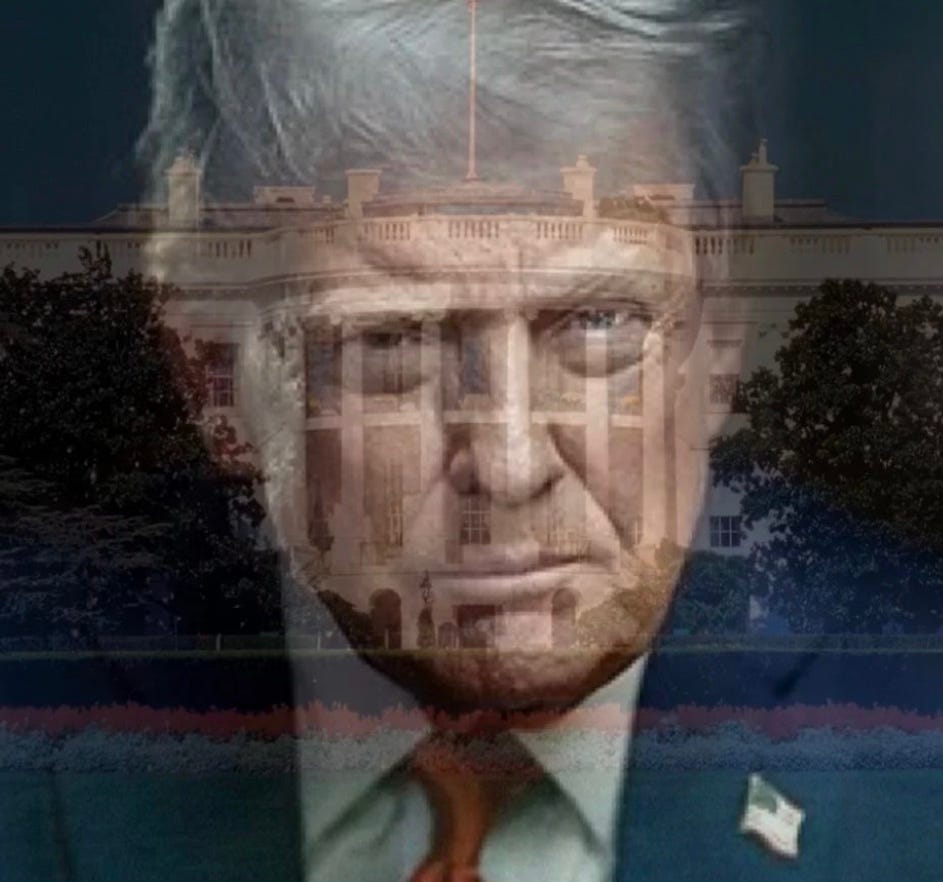
This year at Philosophy Portal we are unfolding a new course, Marxist Politics for Undead Millennials, led by “The Last Marxist”, Chris Cutrone. Throughout the course we will be thinking American Revolution, Trump, Lenin, Critical Theory, The Party, and much more. To find out more or to get involved, visit the link below:
What can be found below is an edited reflection offered by Marxist theorist Chris Cutrone informed by a question that will shape the upcoming class at Philosophy Portal Marxist Politics for Undead Millennials.
How should we be thinking about a figure like Donald Trump in the context post-neoliberalism?
The discourse we are dealing with now, especially that we are in a second Trump term, is that of post-liberalism. People will call it post-liberalism. I think that’s rather precipitous, meaning there is a difference between liberalism and neoliberalism, otherwise it would never have been called neoliberalism.
I wrote about Trump and Bernie Sanders as parallel figures, meaning that you can’t really understand one without the other. But Trump actively courted Sanders voters much more than Sanders actively courted Trump voters.
Trump is in some ways like an ultra-neoliberal figure. It seems like his entire career is based on neoliberalism. So Trump could be seen as someone who is trying to restore neoliberalism, who is trying to return capitalism to when neoliberalism worked.
And yet Trump also seems to be an anti-neoliberal figure in the sense that he was a dissident of neoliberalism at its inception.
Trump first floated the idea of running for president in 1987. Why? Because of the Black Monday stock market crash. In other words, it seemed like Reagan and Reaganism was actually inadequate to the task of successfully managing capitalism in the stock market crash of 1987. This gave rise to the movie by Oliver Stone, “Wall Street”, emphasising “greed is good” with the Michael Douglas character.
Trump was there, right there, to say Reagan’s policies were not good enough.
Bernie Sanders is also a figure of the 1980s, who was there as a dissident from Reaganism. And so the fact that Trump and Sanders, these dissenters from Reaganism, back when Reaganism seemed successful, come back in during the crisis of neoliberalism, it makes sense.
For me, Trump is a complicated figure when he says “Make America Great Again”. His political career is kind of curious. He floated the idea of of running for president but didn’t end up running in 1988. He joined Ross Perot’s Reform Party in 1992, mostly as a support for anti-NAFTA (North American Free Trade Agreement). When Perot lost, he was like, well maybe Bill Clinton, who also ran against NAFTA is going to be good enough. But then he felt betrayed by Clinton because Clinton ultimately signed NAFTA, an agreement that had been negotiated by George Herbert Walker Bush.
And so Trump was stuck with the Reform Party, but then quit the Reform Party when it got taken over by Pat Buchanan because, as Trump put it, Buchanan was a fascist. So he quit. Trump and Jesse Ventura led a walkout from Perot’s Reform Party.
And then we didn’t really hear from Trump. He supported Hillary Clinton’s Senate campaign. He basically supported the Democrats. So where do Trump and Sanders come from, really?
Trump and Sanders come from the failure of Obama and the disappointment with Obama. Both Trump and Sanders would have been provisionally supportive of the Reform moment that Obama represented, both in the realm of the economy, again, the financial crisis and the wars, the “War on Terror”. Both Trump and Sanders were dissenters from the War on Terror and they were dissenters from the neoliberalism that led to the crisis of the financial crash and the Great Recession of 2008. Both Trump and Sanders were critical of how Obama handled those things.
In other words, Obama seemed to betray or let down the promise of his own presidency.
So both Trump and Sanders came up with the idea of running for president in 2016 in 2012, as a result of being disappointed with Obama and with the campaign he ran. They both kind of grudgingly came around to, you know, ultimately having to put their hat in the ring, but obviously very differently.
Sanders never meant to be president, and he never even meant to be the candidate, because he knew that that wasn’t in the cards. He was a message candidate, he was trying to affect the Democratic Party platform. He was trying to show the Democrats how they could win the Obama vote from 2008 back, and how they needed that vote to succeed. He was trying to show the Democrats how they should appeal to that vote, you know, in terms of a reform agenda and program. That is what his candidacy was about, it was about winning back the youth vote that got disenchanted with Obama on an economic message.
Trump, on the other hand, is very different. He didn’t want to be a message candidate. He wanted to be president. For Trump, there’s no point in running at all unless you’re going to win. So contrary to Sanders, he wanted to be president. Then the question is: why did he want to be president?
Trump had toyed with the idea of being president for so long, for 30 years or more before he decided to run, well before the 2016 election. So why did he finally do it? And why did he want to be president? Like, what is the point?
You have to read his books, because he wrote books about it where he said explicitly, ‘this is what you can do as president’, ‘this is what the presidential powers would allow me to do’, ‘and this is what I’m going to do’. It is mostly about tariffs, it is about things that he thought he could do unilaterally as president, which is complicated because, of course, tariffs, it seems obvious that it has to be passed by congress or whatever. But he looked also at what Obama, and also Clinton, did in terms of things like NAFTA and the Trans-Pacific Partnership (TPP). He looked at how they had been negotiated. He looked at how China’s entry into the World Trade Organisation (WTO) had been negotiated by Clinton. And it was not based on congressional legislation, it was based on a lot of executive action. So he took the lessons of that, and said, ‘I could do better’, ‘I’d get a better deal for the United States’.
And so Trump took all these discontents with neoliberalism, how he felt that it had been botched going back to Reagan, and how the potential of neoliberalism had been squandered, including the peace dividend at the end of the Cold War, and said ‘I can do better than Bill Clinton did’, ‘I can do better than Obama did’.
And, you know, he was not a George W. Bush supporter, right? So he did a hostile takeover of the Republican Party. He overthrew the Republican Party of Bush and Cheney and of McCain and Romney. And, in his way, Trump signalled that through personal attacks on McCain and Romney, and on Liz Cheney, like seemingly gratuitous personal attacks, but they mean something.
Key readings for class on March 29th:
Cutrone, C. 2023. The Sandernistas: the final triumph of the 1980s. In: The Death of the Millennial Left. Sublation Press. p. 85-96.
Cutrone, C. 2023. Why not Trump? In: The Death of the Millennial Left. Sublation Press. p. 97-102.
Cutrone, C. 2023. The crisis of neoliberalism and Marxism in the age of Trump. In: The Death of the Millennial Left. Sublation Press. p. 103-108.
Cutrone, C. 2023. The Millennial Left is dead. In: The Death of the Millennial Left. Sublation Press. p. 109-118.
Cutrone, C. 2023. Why I wish Hillary had won. In: The Death of the Millennial Left. Sublation Press. p. 119-122.
Cutrone, C. 2023. Why not Trump again? In: The Death of the Millennial Left. Sublation Press. p. 123-128.
Key prompts/questions:
Why should we think of Trump and Sanders as parallel figures?
What is the difference between “post-liberalism” and “post-neoliberalism”?
What are the core antagonisms between Reagan’s style of neoliberalism and Trump’s style of post-neoliberalism?
How would Trump have negotiated ‘better deals for America’ than Clinton and Obama regarding both NAFTA and TPP?
What are the core differences between Trump’s motivations in his first and second terms?
Why did Trump provoke so much hysteria on both sides of the political spectrum?
How did Trump manage to organise such a passionate base? What is wrong with conceiving of this base as ‘right wing populism’?
To learn more about the course Marxist Politics for Undead Millennials, or to sign up: