
Apocalyptarian Hyperhumanism
Month in The Portal dedicated to thinking international networks

This month in The Portal we will be hosting Layman Pascal and Carl Hayden Smith for a series of sessions oriented around the concept of “Apocalyptarian Hyperhumanism”.
Apocalyptarianism is a term originally developed by Pascal in an article for Metapsychosis1 and presentation at The Stoa,2 and points towards the sense that we find ourselves in a “time between worlds” as our very background condition for being. Pascal notes that the old world has already imploded, and while we desire for a new world to emerge, our true struggle is found in learning how to cope with the “apocalyptarian” “liminal necessity” of inhabiting a “time-between-worlds-ness”. Here Pascal’s work with The Integral Stage can be seen as attempting to model out and stage/embody the ethics of this disposition.3
Hyperhumanism is a term developed by Carl Hayden Smith for the Abyssal Arrows anthology,4 and also presented at The Portal in 2024.5 Smith uses “hyper”-humanism to differentiate his thought from not only humanist thought — which he believes too much centers the human as a special creation separate from nature — but also transhumanism, posthumanism and metahumanism. These variations on humanism either misrecognise the role of technology in human evolution (transhumanism), imagine a universe in which human beings are absent (posthumanism), or too easily reduce the human being to just another organism in a wider ecology of life (metahumanism). For Smith, hyperhumanism represents a “North Star” and orbits the lack-potential in the question “are we human yet?”, reflecting technology not as an end, but as a social bridge to deepen our humanity.
In this month’s sessions in The Portal we will attempt to combine both the terms “Apocalyptarianism” and “Hyperhumanism” to investigate how contemporary online networks can get better at inhabiting “time-between-world-ness” with “hyperhuman” practices and perspectives. We framed the month as a whole in a discussion which I recently hosted on the Philosophy Portal YouTube channel:
Throughout the month the term “Apocalyptarian Hyperhumanism” will be situated in the political and technocapitalist context of “accelerationism” as a dominant cause for both the “time-between-worlds-ness”, and also the breakdown and proliferation of “humanist” variations. Accelerationism is a term closely associated with Nick Land’s anti-philosophy which supports the blind intensification of technocapital as the truth, even if it comes at the expense of human reality. At the moment, the dominant political response to accelerationism include the idea of establishing “ethno-state” or “religious-state” enclosures (on the right), or a movement towards “post-labour economics” (on the left). While there is a truth in the motives of both orientations, from the view of “Apocalyptarian Hyperhumanism”, neither of these responses adequately address the moment:
ethno/religious-state enclosures do not work with the lack/antagonism constitutive of the human subject as such (leaving it in the domain of an external opposition (either ethnic or religious)); and
post-labour economics is too reductionist in its analysis of the human, leaving out the spiritual-cultural dimensions that need to be directly addressed and worked with if we are to cultivate a politics of passion and leisure beyond wage labour.
For Pascal, an “Apocalyptarian Hyperhumanism” would be addressing accelerationism through the cultivation of new shamanic networks focused specifically on existential training orbiting “inner lack/antagonism” to produce higher social coordination that assimilates the darker nature of our drives. This would result in a shift of focus from “artificial general intelligence” (AGI), which is ironically produced by a very narrow/specialised form of human cognition, towards “human general intelligence” (HGI), which is intimately related to the general maturation of international, developmental, and intergenerational social networks that straddle the liminal space between the local and the universal, the digital and the physical.
For Smith, “Apocalyptarian Hyperhumanism” would be addressing accelerationism beyond the myth of “transhuman progress”, where we imagine the transcendence of the mortal-limited human body, and instead cultivate a “humaneness” oriented around care and kindness as more important virtues/values than intelligence. Smith notes the centrality and necessity of a shift to humanness, care and kindness because great suffering and heartbreak is both fundamental to the human experience, and also the core source of real learning and growth. Here Smith critiques positivist narratives that we could ever be saved from “success” or “abundance”, and also positivist spiritualities centring “altered states” of higher consciousness. In contrast, Smith’s hyperhumanism forwards the idea of “altered traits” that need to be earned through struggle, as well as forms of “double-consciousness” that allow one to inhabit contradiction in order to bridge different worlds and perspectives.
Together, Pascal and Smith’s work points towards social experimentation, where new worlds are birthed through intersubjective resonances and surpluses; where an international network can become a space of lifelong developmental and multi-generational learning, and the transcendence of reductionist ideologies that either orbit ethnic enclosure, or a world beyond human labour. In short, “Apocalyptarian Hyperhumanism” centres the work of universal lack at the core of subjectivity in order to forward the question of the human as a fundamentally intersubjective process.
You can find the schedule below for our events below:
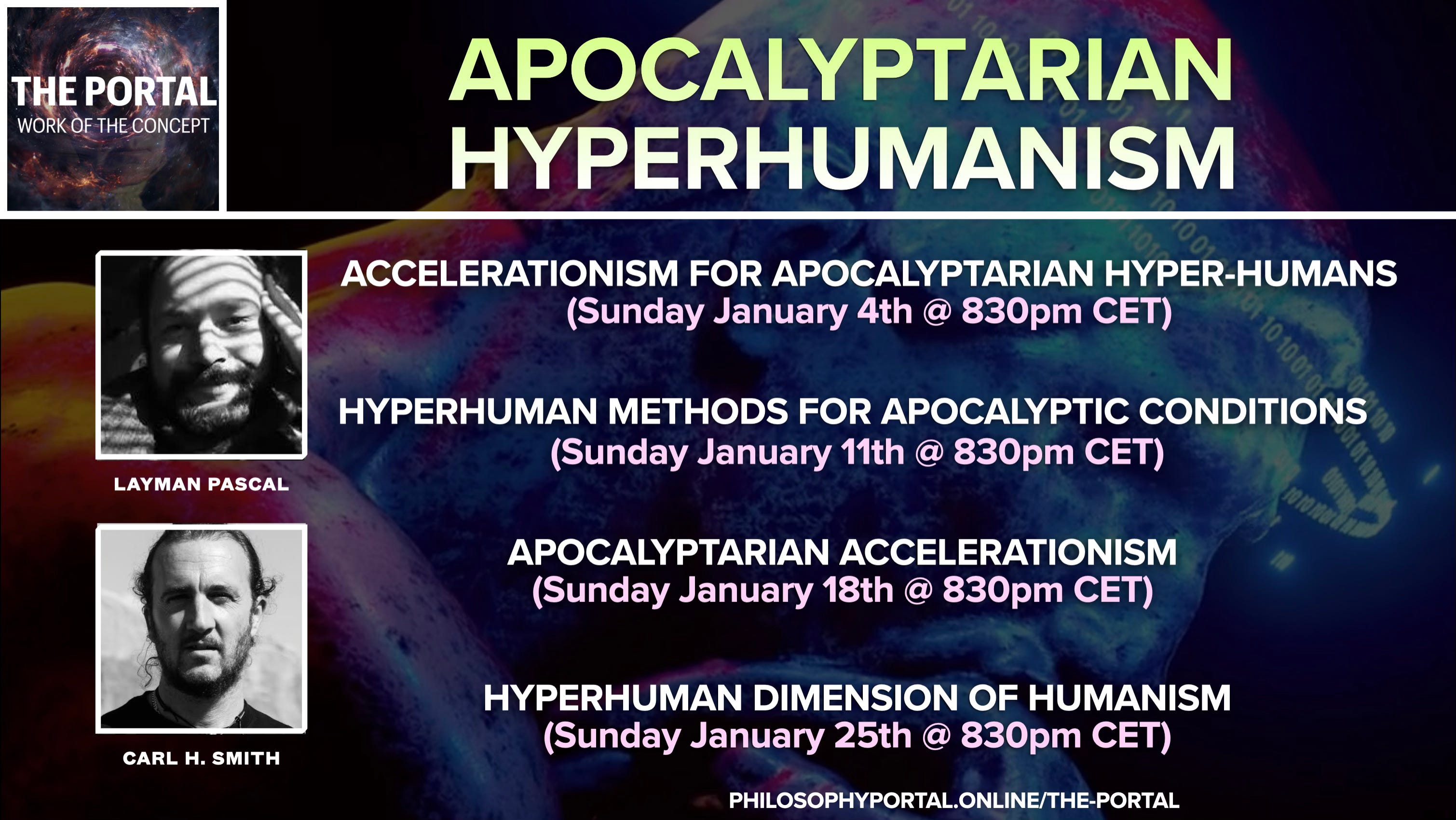
Members of The Portal will get access to all four events, including the entire recorded history of our work:
You can also sign up for the month as an independent course through either Layman Pascal or Carl Hayden Smith directly:
Smith, C.H. 2023. Overbecoming: Hyperhumanism as a Bridge Towards Interbeing. In: Abyssal Arrows: Spiritual Leadership Inspired by Thus Spoke Zarathustra. Philosophy Portal Books. p. 547-574.
whats fascinating here is how apocalyptarianism inverts the usual relationship between crisis and action. normally we think "crisis demands response" but Pascal is saying the crisis IS the response already happening, and our job is to learn how to dwell in that transformation rather than complete it. the "time between worlds" framing is doing serious phenomenological work because it refuses both nostalgia (the old world was fine) and progressivism (we just need to reach the new one). instead youre stuck in pure becoming without end state guarantees. hyperhumanism as Smith develops it is the perfect complement because it asks "what would it even mean to be human if we stopped treating humanity as something we already are." the question "are we human yet" is genuinely unsettling because it implies the human has always been a project rather than a starting condition. combining these creates something like a practical existentialism for network culture where the lack at the center of subjectivity becomes generative rather than pathological
Brilliant synthesis of Pascal and Smith's frameworks. The critiqu eof both ethno-state enclosures and post-labour economics as reductionist gets at something I've noticed in my own conversations around technocapitalism: most responses either double down on identity or economic structures without engaging the existential core. The shift from AGI to HGI is particularly compelling because it reframes development not as individual enlightenment but as genuinely intersubjective practice.